Monitoring large carnivores in the Serengeti landscape involves much more than locating animals and recording their presence. Every sighting is the result of a field process: time spent searching, environmental conditions, animal behavior, visibility, movement through the landscape, and the circumstances under which animals are encountered. The information collected during these encounters therefore represents not only what animals were seen, but also the conditions and effort involved in observing them.
From June to August, the Big Cat Project continued field monitoring of lions, leopards and cheetahs. Daily observations documented species, numbers, group composition, behavior and location they are seen, while also capturing the environmental factors under which animals were encountered. These observations were made within an active tourism landscape, providing an opportunity to consider big-cat sightings not only in terms of what was observed, but also how and under what circumstances animals were being viewed. This report covers our field findings for lions, leopards, and cheetahs in the Northern Serengeti. It breaks down the cats we have monitored and provides information on the tourism that is going on around here.
Operations
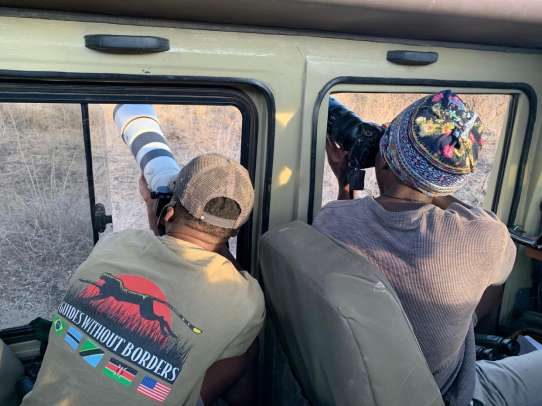
The Big Cat Project relies on opportunistic surveys conducted during daily guest game drives. Biologists ride along with safari guides, acting as extra pair of eyes to help locate big cats based on their knowledge of known home ranges of the cats. In return, the biologists enrich guests experience by translating field observations by sharing deep insights into animal behavior, family relations, territorial boundaries, and individual life histories.
Recently, the integration of technology has modernized our fieldwork. Transitioning to digital data collection using Zoho Forms has standardized our data across the biologist team. This digital shift has minimized data entry errors, prevented information loss, and simplified long-term analysis by directly linking field data with animal identification photographs. Complemented by regular workshops and mentorship, the refined protocols of our operations now have improved our data integrity and advanced our scientific rigor.
Looking ahead, our next step involves training the team on the use of specialized AI software (Argus Wild) for individual identification of leopards and cheetahs. Automating this process will significantly scale up our monitoring capabilities, directly supporting our primary objective of big cat conservation. Operating continuously since 2014, the Big Cat Project holds over a decade of knowledge. Multiple generations of biologists have monitored this landscape, tracking how the Serengeti has changed both ecologically and in terms of anthropogenic activity over the years. This deep understanding of animal behavior and the landscape, combined with a strong foundation in established guiding ethics, uniquely qualifies our team to manage and interpret this field data
Big Cats
Cheetah
Throughout the monitoring period, the team tracked a total of six individual male cheetahs: a lone male named Tunchie (monitored since 2025), a three-male coalition known as "The Wanderers" (tracked since 2023), and a newly recorded coalition of two brothers. All individuals appeared healthy, in excellent physical condition, and were documented hunting and feeding on successful kills.
Tunchie was located within the same home range he occupied in 2025, which extends from the Gardenia Plains to the Nyamalumbwa Mountains. This spatial fidelity offers clear evidence of resident male territoriality, confirming that the area provides high-quality resources, such as sufficient prey and access to mates. In cheetah ecology, a resident male will only invest energy into defending a fixed territory if it yields reliable access to moving females. While no female cheetahs were recorded in this specific zone during the reporting window, their presence is highly probable. Because females maintain vast, non-territorial home ranges and our visual surveys are strictly restricted to established tourism tracks, cryptic females remaining deep in the off-road bush are difficult to detect.
Similarly, The Wanderers have maintained their historical home range, a massive territory stretching from the Mara River all the way to the Kenya-Tanzania border. This area directly overlaps with the territories of multiple dominant cat competitors. This includes lion prides Lamai and Kenyangaga on the Lamai Wedge side where they are most frequently seen. When the cheetahs cross the river to Kogatende side, their range overlaps with even more resident lion pride territories, alongside several resident leopards and transient nomadic lions.
The fact that these cheetahs survive in such a high-risk landscape shows exactly how they coexist with dominant predators. To avoid lethal encounters and injuries, they rely on fine-scale temporal avoidance. This means they utilize the same geographic spaces as the lions and leopards, but simply shift their activity to different times of day. They combine this with sharp reactive avoidance, actively assessing immediate local risks and altering their movements the moment a competitor is detected nearby.
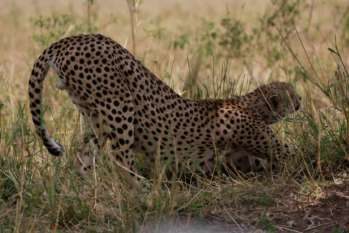
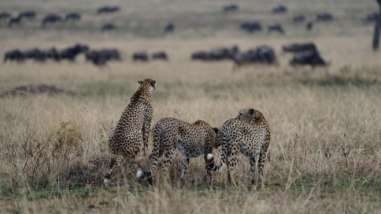
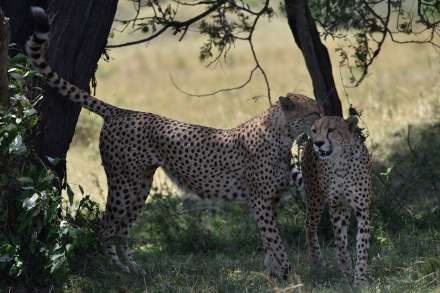
We sighted a coalition of two males at the end of August. These were new males encountered for our database. We observed them moving through the area, marking their territory, and they also tried a hunting attempt. However, they spotted hyenas far off on the side where the prey were and decided to give up the hunt for that day.
Leopard
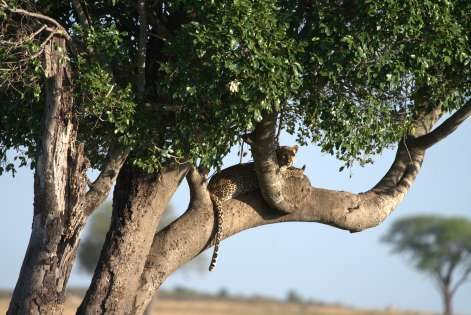
Leopards in The Northern Serengeti are easily the hardest cats to track. They are elusive by nature, and the local geography gives them endless places to disappear. Because the landscape is filled with deep drainage creeks, big trees, rocky outcrops, and thick bush, these predators have plenty of cover to utilize. At the very start of the season, while Njozi Camp was still setting up, we saw a resident female resting in a tree right next to the campsite. While we haven't physically located her again since then, we still hear her roars at night, confirming she’s around
Across our study area, you can find leopards almost anywhere, but they are especially tied to the rivers. We located one male resting in a bushy tree right at River Crossing Point 2. Areas close to the river are prime hunting grounds because prey animals have to come down to drink. During the migration, wildebeest river crossings also provide high-success ambush opportunities for these cats.
On the Lamai side, we had a few direct sightings, including a male at Korongo la Saa Kumi and another leopard at Kenyangaga. However, we found more indirect evidence across this area, with multiple carcasses hoisted up in trees. This included an ostrich, which is a very unusual sight. These carcasses tell us there are likely many more leopards here than the two we actually saw.
The rocky kopjes are another fascinating spot for leopard activity, especially since this is claimed territory for a lion pride, the Wogakurya pride. Coexisting with such a dominant predator is a challenge, but the leopards use these rocks as a safe refuge.
At Mawe B, we’ve been monitoring a mother leopard named Mama Mkali. She has a new female cub about three months old, and despite living right in the middle of lion territory, she’s successfully raising her. We even saw her with a kill recently, showing she’s thriving. Her male cub from last year, Mkali, hasn’t been seen this year and has likely dispersed to find his own territory.
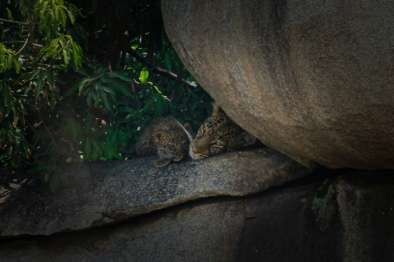
Mawe ya Nomad, we found another female here with a male cub around 5–7 months old. Their behavior is different from what you see with lions or cheetahs at this age, leopard mothers often leave their cubs alone for long periods while they hunt, effectively "caching" them in safe spots to keep them away from competitors. We saw this female perched on the very top branch of a tree one day, scanning the area attentively. This is a classic survival tactic where leopards climb to the absolute highest branches where a lion's weight makes it impossible for them to follow. Sure enough, we found lions nearby shortly after.
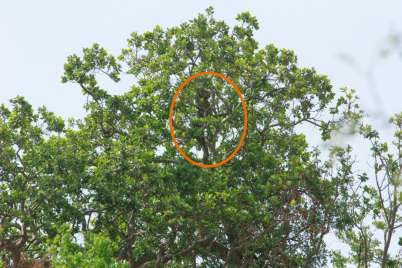
The sheer number of mothers and cubs we’re seeing across these kopjes is a great sign. It indicates there’s at least one dominant resident male attending to these females, even if he stays out of sight. As for young Mkali, if he made it to adulthood, he’s almost certainly dispersed to find his own range, as young males typically do. We also had two very brief sightings: one big male at the Kogatende Airstrip and another male at Kisima cha Kaburu (the pumping station). They both vanished into the bush within seconds, but just knowing their ranges is a start. If they become more cooperative with the vehicles later, we can hopefully get the photos we need for a full IDs.
Lion
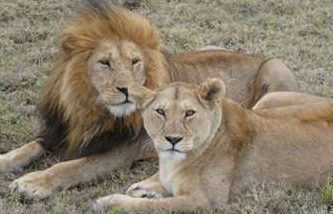
Monitoring lions in the Northern Serengeti is another area of expertise for our team. Lions are highly territorial, and their prides typically maintain stable home ranges across generations. Over our years of field operations, we have successfully monitored and recorded a total of seven distinct prides. On the The Northern Serengeti side, these include the Machochwe, Korongo la Hewa, Wogakurya, Gardenia, and Sand River prides. Across the river on the Lamai Wedge, we track the Kenyangaga and Lamai (4 O'clock) prides. Very recently, the Sayari pride was added to our monitoring list. While we do not yet have sufficient data regarding their specific pride individuals or complete home ranges, we are actively building their baseline profile. The following accounts detail the observations and information collected on the resident prides during this reporting period.
Wogakurya pride
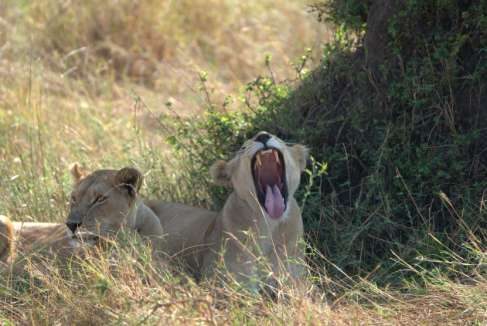
This is a very large pride, both in individual numbers and the size of the area they occupy. Their territory extends to the vast network of kopjes, which make a perfect home for these lions. The rocks give them a lot of natural advantages, big trees provide cool shade during the hottest parts of the day, deep crevices give them places to hide and protect their cubs from other predators, and the high rocks act as great lookout points to spot prey or threats. Most importantly, these rocky hills give mothers a safe, hidden place to keep their newborn cubs away from danger.
Kopjes provide another major benefit because they can support different kinds of plants compared to the surrounding flat plains. The deep cracks and hollow depressions in these massive granite structures trap and store rainwater for long periods, while also catching nutrient-rich soil and leaf litter. This reliable moisture allows thick bushes and trees to stay green year-round. This vegetation acts like a magnet, constantly drawing in all kinds of grazing animals looking for food and shade. Because the prey herds come directly into the rocks, the lions do not have to waste a lot of energy searching for food. This drastically increases their hunting success and makes the kopjes an ideal territory for a large pride
From our last year's observation, the pride had formed 3 different subgroups. In lion behavior ecology these groups are called fission-fusion groups. This occurs when the main group splits into smaller groups (fission) and reunites (fusion). They do this in order to balance foraging costs of being in large groups, as living in large groups means more competition for food. Splitting up and reuniting this way increases the success of raising cubs. These subgroups from the Wogakurya pride are Woga A, Woga B, and Woga C.
Woga A: This group has 3 mothers with five male cubs whose age now is about 2 years. Their range goes from Mawe A, B, and C all the way to Mawe ya Nomad and Mawe ya 200. Currently, we have been able to locate 2 of the young males, but we haven't seen the mothers yet.
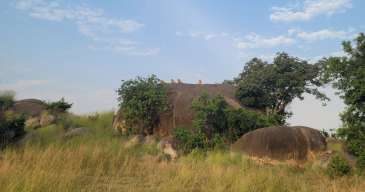
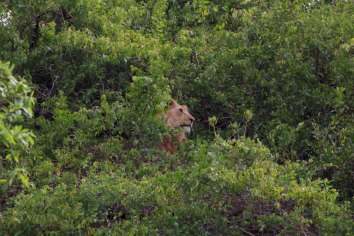
Woga B: This is the largest group in the pride. From last year's data, we had more than 6 females that we followed and a total of 20 cubs. This includes 4 very new cubs that we saw at the end of last year's season when they were about 2 months old. We saw them by chance as the mother was moving them from one rock to another, and they were very tiny. Currently this year, we have seen 3 females and 4 cubs that are about 4 months of age. This group also covers a vast area from the Mama Kenty Creek to Mawe ya Olakira, Mawe ya Chupa, and Mawe Pacha. This is a big, very resourceful area for the group.
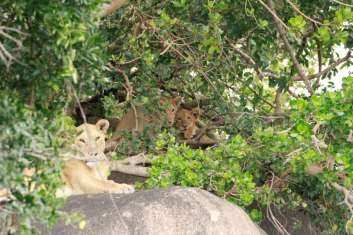
Woga C: This group has been the hardest to locate and follow up on. Last year, there were more than 4 females, 2 male cubs that were about 1.5 years of age, and 2 other cubs that were about 8 months old. One of the females was on a honeymoon with the males of the pride. Currently, we have followed up with 3 females of the group. This group occupies the area called Mawe Sayari.
Gardenia pride
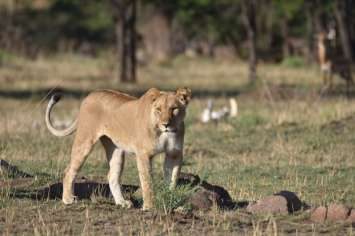
The Gardenia pride gets its name from the flowering plant (Gardenia jasminoides) that grows in this territory. The local area is called Gardenia, and that is where this pride lives. This is a very resourceful area in the Northern Serengeti because it has open plains, while the rest of the Northern Serengeti is mostly rolling hills and tall grasses. Most of the time, the area is filled with herds of wildebeests, topis, zebras, and elands. The Bologonja and Gardenia creeks provide a reliable water source throughout the year, and all these creeks flow into the Mara River, making the area perfect for a pride setup.
Currently, we have seen two groups of the pride. One consists of 3 females and 3 male cubs. These cubs are almost a year old now. We first saw them last year when they were only about 2–3 months old, and seeing them grow up shows how successful the Gardenia pride is. Another group consists of 5 females and their 5 cubs. A separate female was spotted alone far off at Jerry Creek; she looked heavily pregnant and was likely seeking the right spot for delivering.
The pride has been under the rule of three males since their takeover in 2024. Initially, that coalition entered the area as six males. Over time, we noticed one male with a puncture wound, and shortly after, the group dropped to just three. The other three males disappeared, and the territory has since been under the control of the three remaining males.
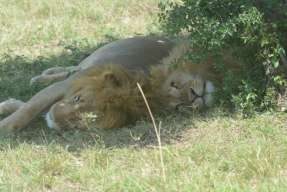
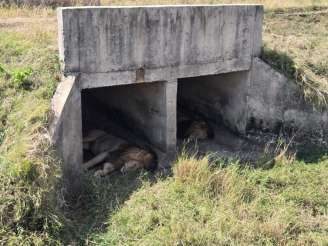
We recently encountered three new males in the territory. These majestic, dark-maned males must have kicked out the previous pride males. At the start of the season, we first saw two of them resting under a bridge along Gardenia Creek. Like the previous males, they prefer sleeping under the road culvert for the shade. They were also marking their territory, giving us clear insight into how tough it is for males to hold a territory. In resourceful areas, competition is intense, so holding a territory requires strong males.
On August 29th, we encountered the same two dark-maned males, now joined by the third dark-maned male at Jerry's Creek. The three males were closely pursuing two young females who appeared to be in estrus. The females resisted the advances, backing each other up as the males approached. Meanwhile, the males carefully sniffed the ground and performed a flehmen’s response. At one point, one male sprayed urine on a nearby bush and went back to rest in the shade.
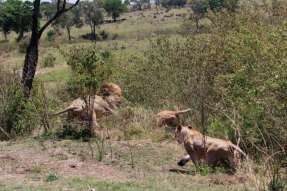
Flehmen’s reponse is a behavioral mechanism where a cat curls back its upper lip to expose its front teeth and inhale scents into a special organ on the roof of its mouth called the vomeronasal organ, allowing it to process chemical signals and accurately evaluate a female's reproductive status.
Following the arrival of these new males, we noted a big shift in the behavior of the pride. Across the creek, about 4 km away from the males, a group of mothers with their cubs was seen resting under a tree for shade. The females likely moved to this area to avoid potential infanticide from the incoming males. We will keep monitoring their movements to gather more accurate data on these dynamics.
Lamai pride
Found on the other side of the Mara River, the Lamai pride holds one of the best territories in the area, very well selected. Their range extends along a creek that is ecologically important for lion survival, called 4 O'clock. The name originates back in the day from resident guides who used to mostly see these lions around 4 o'clock but not at other times. Most of them believed the lions only came out at that specific time, so the name got famous, and everyone started referring to the pride as 4 O'clock.
Currently, the Lamai pride stays in two major groups. The adult group is composed of 2 adult males, who are the protectors of the pride, and 5 adult females. Of these females, 4 are old seniors and one is younger, aging about 3.5–4 years with 6 cubs of 6 months. These queens are the true owners of the territory.The other group consists of 5 sub-adults (one female and four males) whose ages we estimate between 1.9 and 2.5 years. These young males are slowly transitioning to independent life. Soon, they will be kicked out of the pride and enter their nomadic phase.
This will be interesting as the males leave the young female should attach more closely to the older females.
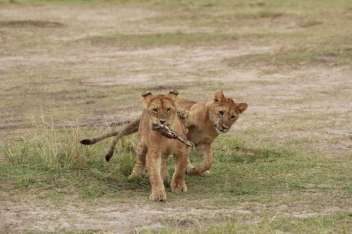
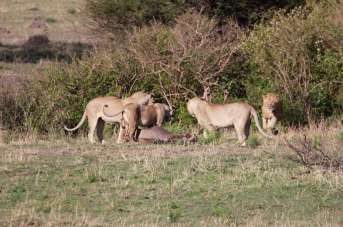
Kenyangaga pride
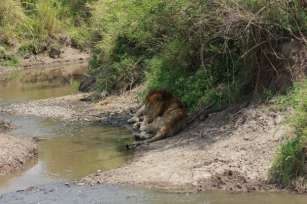
This pride is not seen as frequently as others. Last year we did not collect data from this pride, but good enough this season we have observed them and updated our data.
As always, a lion pride's territory is strategically selected. We see this on the pride as it resides on this creek, a territory which is visited by herbivores when they want to have a drink. We observed a mating pair from the pride. With continued observations and monitoring, we will have good updated information on the pride.
Korongo la Hewa pride.
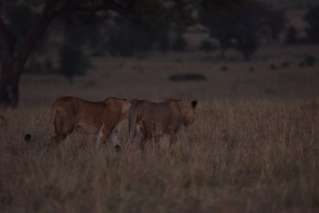
This pride is not frequently seen because it ranges in inaccessible areas of the park. It is a big pride too.
Last year we had good encounters with two males of the pride and recently on 29-08 we encountered pride females and their cubs very early in the morning. They were moving and went down the creek. It was a total of 9 lions, with 3 adult females and cubs. It was still dark at 0640 in the morning just after the sunrise, so we had limited time to analyze their composition.
Border Lions
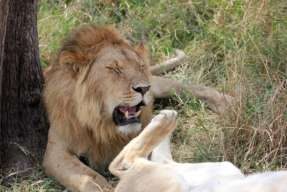
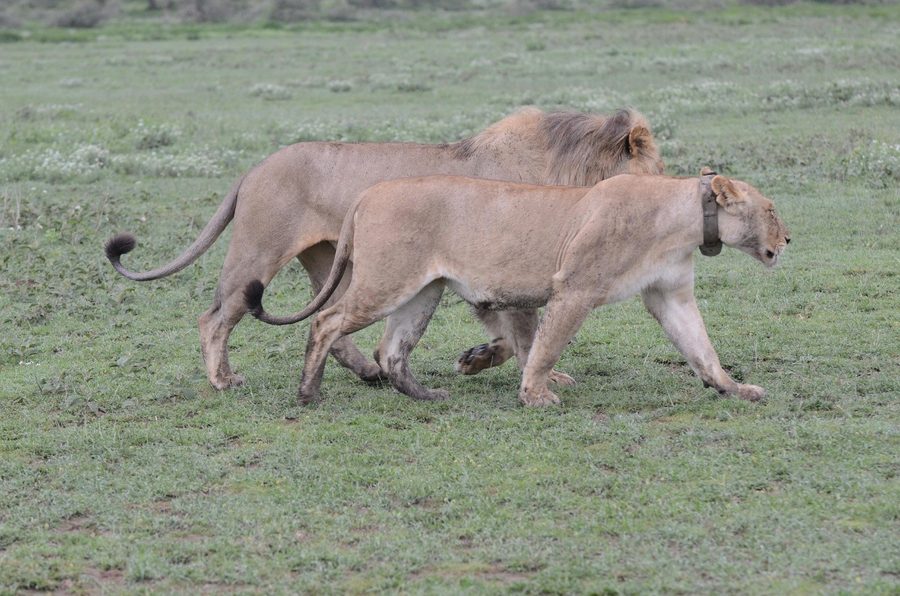
We observed a mating pair near the Kenya-Tanzania border. The vastness of the northern Serengeti provides so much room for big cats, which is why we even see nomads in the area. Nomads are lions who do not have a specified territory. We noticed this pair on a honeymoon in an area which is not a known Tanzanian pride territory. We identified the lions but we could not get any matches for them from our database. Because of this, we think these lions are members of a Kenyan pride and have extended their range in Tanzania. After all, lions do not need passports. They are kings of the jungle.
| Cat | Male | Female | Cubs |
|---|---|---|---|
| Cheetah | 6 | None | None |
| Leopard | 2 | 4 | 2 |
| Lion | 7 | 24 | 31 |
Tourism
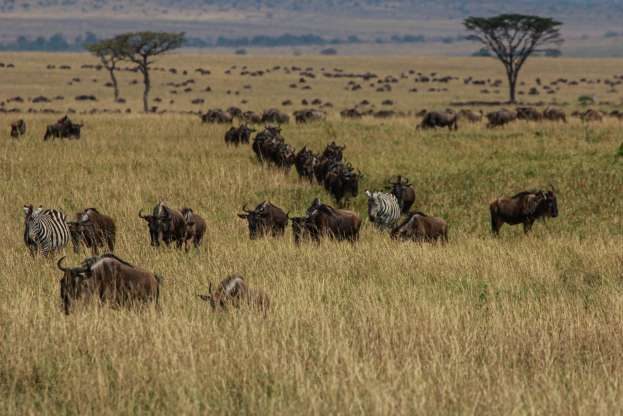
The Northern Serengeti hosts one of the most remarkable wildlife spectacles in the world. Every year, more than two million herbivores gather here during their annual migration, a pattern that has continued for millions of years. The Mara River acts as a major natural barrier that these herds must navigate during daily grazing movements and their broader migration routes. Travelers from all over the world come to witness this event, which displays a wide range of fascinating wildlife behaviors. Because most safaris focus heavily on the Northern Serengeti at this time of year, The Northern Serengeti experiences a massive influx of vehicles and high camp occupancy. This sudden spike in human presence introduces a challenging layer to what we define as "viewing conditions".
When we evaluate viewing conditions, we are looking directly at how animals react to human presence. Factors like vehicle density, proximity to the animals, and noise level collectively can change wildlife behavior over short or long periods. This human presence does not just affect the big cats it impacts the entire ecosystem, especially when crowding leads to unethical interactions and regulation are not followed. Through daily monitoring, our data allows us to log the exact number of vehicles present at each big cat sighting and record how individual predators respond.
Cheetah
Cheetahs are the rarest large cats to see in The Northern Serengeti. Because sightings are so uncommon, whenever they are spotted, they attract most of the guides and their guests to come and watch. This heavy concentration of vehicles changes the sighting environment completely. Whenever there are many vehicles, there are high chances to disturb the animals. This happens because drivers are constantly repositioning their vehicles to get better photo angles for their guests, while engines run and people talk inside the trucks.
This extreme presence of many vehicles, especially on cheetah sightings, can lead to off-roading, which is prohibited by park regulations. When off-roading is overdone, it leads to severe habitat destruction. The kind of soil in the northern Serengeti takes an exceptionally long time to recover. Once vehicles crush the ground, heavy seasonal rains easily wash away the exposed earth. This causes permanent soil erosion and reduces the quality of the area.
Leopard
Leopards are widely distributed across The Northern Serengeti, but they stay at the very top of almost every visitor's must-see list. Whenever a leopard is spotted, it routinely triggers a massive rush of safari trucks. If these sightings are not regulated, it quickly leads to serious disturbance for the cats. Getting too close makes the leopards visibly uncomfortable and they show clear stress responses like constantly moving around or climbing down from their trees to find deep cover.
While people might easily overlook these immediate reactions, continuous disturbances can cause serious long-term changes in their behavior. This negative effect can be seen in all three big cats. As a short-term response, a cat will simply retreat into thick bushes where vehicles cannot follow, forcing them to stop their daily activities. When there is too much human presence, these cats choose to stay put in one hidden area just to stay safe, which leaves them with less time to hunt and find food (a trade to their fitness). Over time, these cats can develop a total avoidance behavior toward these high-use tourism areas.
Lion
As the kings of the savanna, lions are a universal favorite for both guests and guides. Sighting them remains a highlight of any game drive, even when the pride spends most of the day resting or sleeping. What makes watching lions so uniquely compelling is how much their social structures mirror human behavior. Psychologically, the deep connections within a pride reflect our own lives. The gentle, protective way lionesses interact with their cubs mirrors human motherhood, while the playful, high-energy antics of the cubs closely resemble human babies. This deep bond and affection within the pride are precisely why lion sightings connect so strongly with human observers.
Because lions are such a major attraction, they always draw the biggest crowds on game drives. This means it is up to safari guides, as leaders in the field, to truly understand these animals' behavior and act ethically so we don't disturb them. Crucially, the total number of vehicles isn't always what causes the most stress. A sighting with just two badly managed trucks can cause far more disruption than thirty well-behaved, silent vehicles parked at a respectful distance.
To keep from disturbing the big cats, our team always follows four basic rules when we are on big cats sighting, and we actively advise other guides and to do the same.
- Proper vehicle positioning: We make sure to park at a respectful distance and ensure the truck never blocks the animal’s view or the direction it is trying to move.
- How we approach the animal: We always read their body language first to make sure they are completely comfortable with our presence before drawing closer.
- Managing noise levels: We make sure to turn off vehicle engines completely and keep speaking volumes low inside the truck while watching them
- Proper tracking of a moving cat: We never tail or closely follow a cat when it is on the move. Tailing a predator ruins their orientation and can dangerously separate mothers from their cubs.
| Cat | Number of sightings | Highest number of vehicle on a sighting |
|---|---|---|
| Cheetah | 6 | 14 |
| Leopard | 12 | 7 |
| Lion | 49 | 14 |
A biologist field day
On the morning of July 30th, we left camp at dawn to find a river crossing. Getting out early is the best way to find the herds and see how they are moving before they decide to jump into the water. We searched downstream past the empty banks of crossing points 0, 1, and 2, until we finally found large numbers of wildebeests gathering at Crossing Points 3, 4, and 5.
Because the south bank always has many bushes, especially at number 4 you cannot view the crossing from this side. We drove across the river to watch from a higher spot on the north bank. From there, we could see everything clearly. We watched a big herd waiting at the edge of Crossing 4 on the other side, and we could also see big herds far off at numbers 3 and 5. It was a long waiting game for sure.
Finally, one animal jumped into the river, and the rest followed. The herds from Crossing 3 and 5 were pulled by the ones crossing and ran down the banks to join the line at point 4. You could feel the pressure from the stampede, and it kept getting louder and louder. After five hours of waiting and watching, the crossing finally happened and took about 40 minutes to finish.
During the crossing, a crocodile came out of the current and took down a wildebeest mid-stream. It was complete chaos, and though the other crossing wildebeests were full of pressure, this did not stop them from crossing. It is always great to see a herd cross the river after you have patiently spent hours waiting and watching them make their choices at the edge.
Acknowledgments
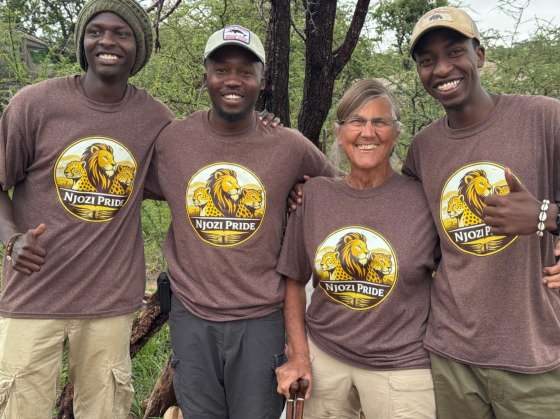
We want to thank our guests as they are the key players here, allowing us to join them on game drives and supporting us through advice and donations to The Wild Source Foundation. We also thank our wonderful guides for the knowledge they pass to us and for being ethical with wildlife. Special thanks to Njozi camp for supporting the Big Cat Project, and congratulations to our team of biologists for our dedication to conservation. That's all.