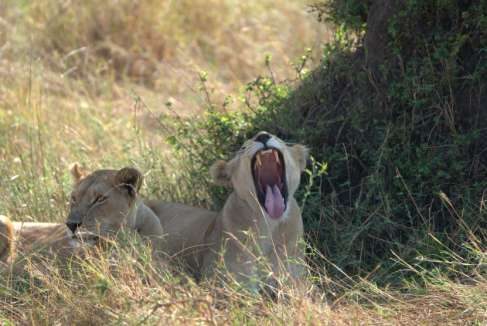
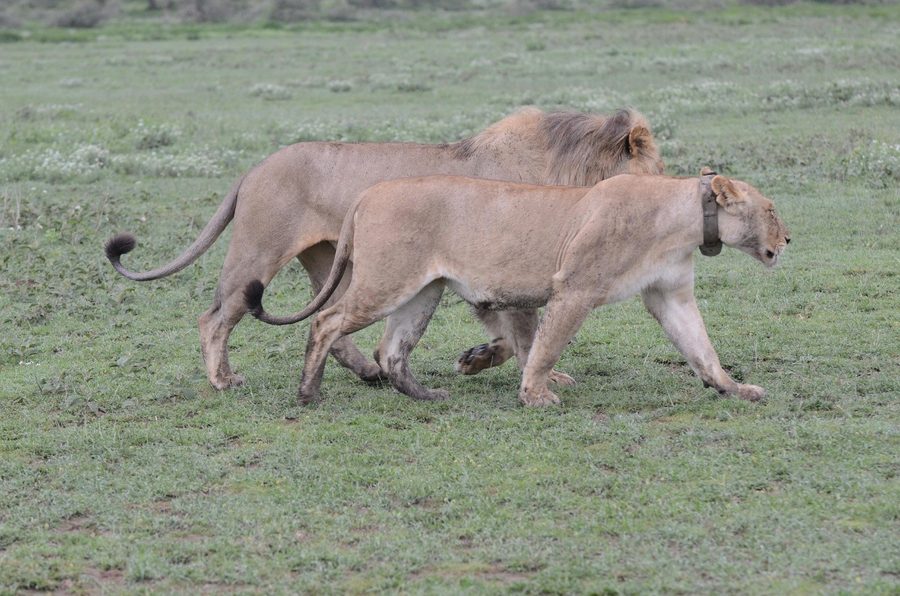
What is the Big Cat Project?
Safari operations can enhance conservation efforts in Tanzania by actively engaging local communities to promote responsible tourism. The Wild Source safari operators have integrated conservation and tourism through the Big Cat Project (BCP).
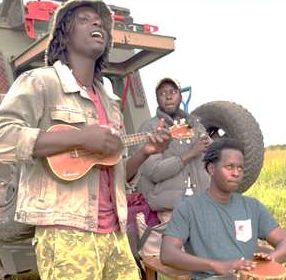
The BCP is conducted by local Tanzanian biologist-guide trainees making observations of lions, cheetahs and leopards (the big cats) in the Serengeti ecosystem, especially in the Ndutu (southern) and Kogatende (northern) regions. They share information about these big cats with safari guests, and use what they learn to promote the conservation of these cats.
The Big Cat Project was started by The Wild Source in 2014. The founders of TWS, Bill Given and Deo Magoye, wanted to use safari tourism as a way to provide new jobs for Tanzanians. They also wanted to provide in-depth information about Tanzania’s big cats to safari guests. They hired young aspiring Tanzanian guides to become biologists and make observations of big cats.
The first BCP biologists were Fadhil Magoye and Sosy Maira. They were later promoted to biologist-guides.
In 2016, David Maira took over the lead of BCP. Then in 2022, Yusuf (“GG”) Magoye succeeded him when David was also promoted to biologist-guide. The team expanded, with Raymos Mbwambo and Benson Makungu joining in 2023 and 2024 respectively. Together, they form a strong team to collect information about big cats and promote conservation efforts.
In 2024, the BCP biologists were joined by the “Seniors Team” of Kathy Frost, Robert Suydam and Bob Small. Kathy, Robert and Bob are retired biologists who share a passion for Tanzania, the Serengeti, and mentoring young people.
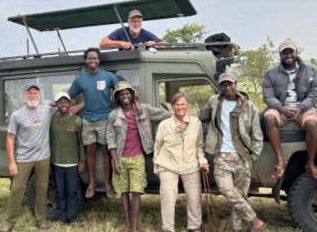
The BCP has several goals:
- 1) Integrate conservation with tourism (safari operations).
- 2) Collect long-term data for conservation purposes.
- 3) Raise awareness of conservation in communities.
- 4) Empower local communities through knowledge and participation.
- 5) Monitor big cat population trends .
- 6) Evaluate the impact of tourism on big cats in their natural habitats.
By fostering a deeper understanding of the environment, local Tanzanians are better positioned to promote conservation in ways that resonate with their communities.
Njozi Camp, Ndutu and the BCP
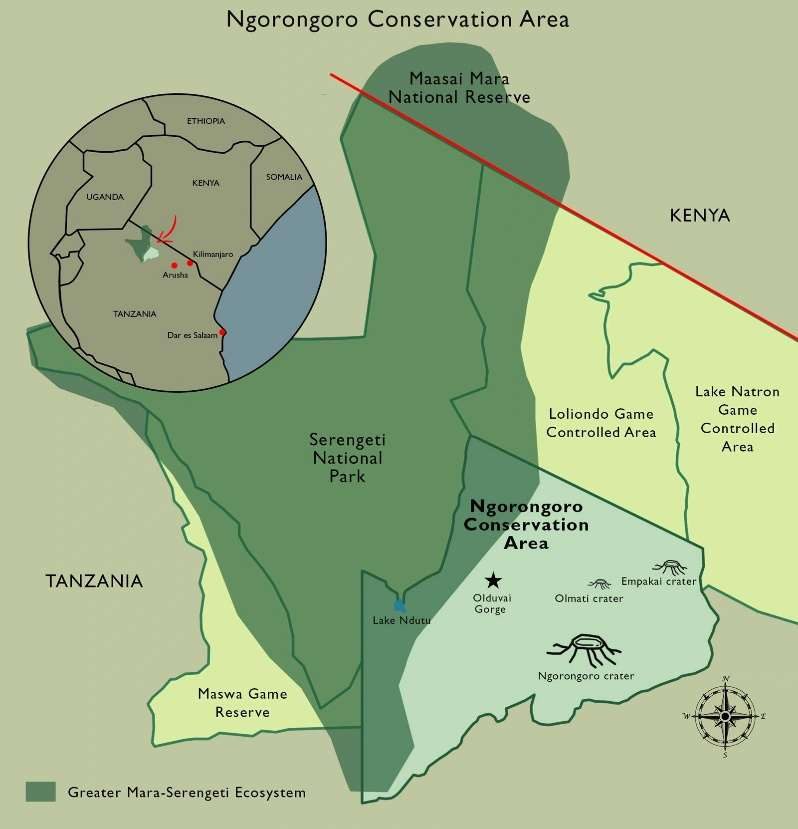
The BCP is active during two seasons: December through March and July through October. The Wild Source’s mobile Njozi Camp is the base of operations during both seasons. The December through March season occurs in the Ndutu region of the Ngorongoro Conservation Area, south of Serengeti National Park, during the “green” or short dry season when wildebeest calving occurs. The July-October season is spent in the Kogatende region in northern Serengeti NP, during the long dry season. Big cat predators are active during both seasons. This first BCP newsletter highlights big cats at Ndutu.
Ndutu is one of the most ecologically significant areas in the Serengeti ecosystem, particularly known for the Great Wildebeest Migration. From December to March, over a million wildebeest, along with zebras and other ungulates, move to Ndutu in search of quality food. The short-grass plains provide highly nutritious forage, essential for lactating mothers and their growing calves, making Ndutu a preferred calving ground of several species during this season. This seasonal abundance also sustains a variety of predators, including the big cats we monitor.
Big Cats in Ndutu
The high density of ungulate prey in the Ndutu region during all or part of the year supports a wide variety of predators. The BCP is interested in the three large cat predators: cheetahs, leopards and lions. Several smaller cats occur in the area, including African wild cats, serval cats, and caracals. Hyenas are also a major predator.
Cheetahs are at the bottom of the hierarchy. Lions, leopards and hyenas all will steal from cheetahs after they have made a kill. They also sometimes kill cheetah cubs.
| Sightings | # Non-cubs | Males | Females | Cubs | |
|---|---|---|---|---|---|
| Cheetahs | 34 | 63 | 44 | 19 | 13 |
| Leopards | 10 | 10 | 4 | 1 | 0 |
| Lions | 50 | 145 | 51 | 71 | 87 |
How we study big cats
The BCP uses direct observation as its primary data collection method. During each sighting, detailed information is recorded as much as possible, including encounter time, age class, behaviors (especially hunting behaviors, predator-predator interactions, cub behavior, belly size, health status (e.g., injuries, body condition), number of safari vehicles present, the cat’s reaction to vehicles, and guide/driver behavior.
We also use the vocalizations of roaring cats (leopards and lions) to help determine their locations. Their sounds assist in tracking the cats and planning morning game drives, often leading to successful sightings.
All animals leave tracks that indicate their presence, even when not directly seen. For elusive species such as leopards, monitoring for their tracks and spoor is particularly useful in confirming their presence and locating them. For example, tracks were frequently seen near Njozi Camp at Ndutu, which prompted guides and biologists to look for leopards. Another example was when "Mama Ndutu", a female leopard, was located using this approach and identified through video and photo analysis.
The Wild Source also receives information and updates from our friends, guides, biologists, and Njozi Camp staff. This includes sightings or locations where cats were seen, particularly about cats spotted at night.
A biologist riding along with guests is a long-standing tradition of The Wild Source. This fosters engagement in science and conservation. A biologist joins guests and their guide on game drives to provide information about the BCP, other information about big cats, and to collect additional data when big cats are spotted. This approach has facilitated data collection while also raising awareness among visitors about cats and conservation.
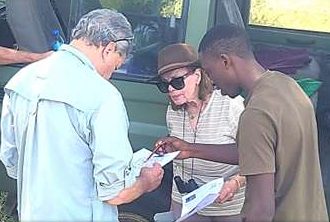
Regular scheduled outings using the Wild Source research vehicle are conducted to track, observe, collect, and record data on big cats. Currently the research vehicle is unreliable and we are looking for funds to obtain a new 4WD Suzuki vehicle for our big cat research.
Njozi Camp itself is crucial for the BCP, supporting data collection on all three big cat species and other species of interest. For example, in the past we have had regular sightings of the Backyard Pride of lions near Njozi Camp, Ndutu. We have also had sightings of the Marsh Pride close to the camp kitchen, “Mama Ndutu," a resident female leopard, a female cheetah and her nearly one-year-old cub, and rare nocturnal species such as African civets and crested porcupines.
Camera Traps
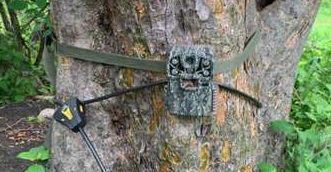
Camera traps are a type of remote camera used to capture photos of wildlife. They record wild animals when humans aren’t present. The cameras are typically equipped with an infrared motion sensor. They are automatically triggered by motion, like the presence of an animal.
The BCP biologists set a camera trap in December 2025-January 2026 at the new Njozi Camp location to document animal activity around Camp.
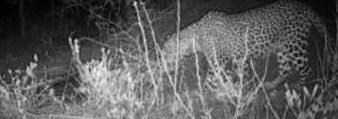

A female leopard was recorded in a single independent event. The camera also recorded a black-backed jackal, white-tailed mongoose, genet cat, civet, and spotted hyena. Multiple camera trap events involved domestic animals, including donkeys, cattle, domestic cats and dogs.
Identification of big cats
BCP biologists have developed procedures for identifying individual cats by using photos taken during a sighting.
Identification features include whisker patterns, spots, ear notches, scars, and any unique markings. Areas of focus differ among the species:
-
Lions: Whisker patterns are unique for each lion. Coat color can also be distinctive, along with features
such as scars, missing teeth, chipped tongue, etc.
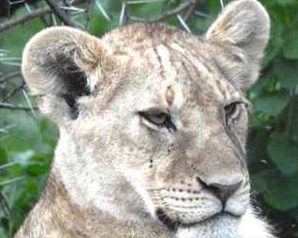
Lioness face showing the whisker patterns. Each lion has a unique whisker pattern. - Leopards: Facial coloration patterns, whisker spots, scars, and ear notches. Rosettes of spots are more complex to match but are still very distinctive.
-
Cheetahs: Spot patterns are the most helpful. These can be spots on the body, on the inside of the legs, and
near the end of the tail.
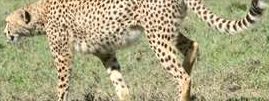
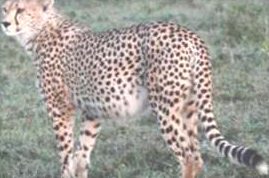
This Marsh Brother cheetah in Ndutu has identifiable spot patterns on the front and hind legs. These photos are of the same Marsh Brother in different years.
Photo identification (ID) starts by capturing multiple images that highlight key identification features. Images are sorted to create individual profiles. Each identified big cat is assigned a unique name and ID number. This is greatly enhanced by our knowledge of the animals. Up until now, photos have been manually matched. Matching by hand is a very labor-intensive process.
Individual ID can greatly improve our understanding big cat biology. For example, individual female cheetahs can be “tracked” or “photographically recaptured” over time to document the number and survival of cubs. Hunting success and prey choice of individual cheetahs and other cats, as well as many other aspects of behavior and biology can also be documented. Collectively, this information can be used to make recommendations about conservation of cheetahs, lions and leopards.
Using AI
The company Tech 4 Conservation (T4C) has been operating an artificial intelligence (AI) photo ID program for various projects in Africa and other places in the world. Like our manual matching, their program is designed to compare photographs and look for ones that are or might be the same animal. This program and the associated software are called the Argus Wild AI.
The BCP has worked with T4C to begin developing a database of cheetah, leopard and lion photographs that can be compared and matched using their AI program. The BCP has thousands of photos of big cats in its archived photo catalog. BCP biologists are working to organize and upload these photos. The T4C software will examine the uploaded photos for matches. When a match is made, the software provides IDs for the individual cats. The process for uploading and identifying photos is in its early stages. Like all AI, it will get better with “training.”
There are several challenges with photo-matching that uses AI. Errors in matching, both false-positives and false-negatives, will need to be assessed and corrected. Uploading photos from Njozi camp, where the internet is slow, can also be a problem, Upgrading Njozi camp’s internet will substantially improve this aspect of photo-matching. We hope Starlink will be available soon!
Leopards
| Year | Field days | Leopard Sightings (per day) | Number non-cubs (per day) | Males | Females | Cubs |
|---|---|---|---|---|---|---|
| 2019-20 | 25 | 1 (0.04) | 1 (0.04) | 0 | 1 | 0 |
| 2020-21 | 3 | 1 (0.3) | 1 (0.3) | 0 | 1 | 1 |
| 2021-22 | 15 | 1 (0.1) | 1 (0.1) | 0 | 1 | 0 |
| 2022-23 | 30 | 1 (0.03) | 2 (0/1) | 1 | 1 | 1 |
| 2023-24 | 35 | 10 (0.3) | 9 (0.3) | 2 | 2 | 3 |
| 2024-25 | 38 | 10 (0.3) | 10 (0.3) | 4 | 1 | 0 |
| TOTAL | 146 | 24 (0.2) | 24 (0.2) | 7 | 7 | 5 |
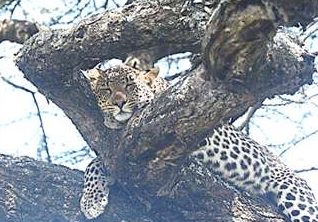
Leopards are most active from dusk till dawn. During the day, they rest in thickets, in the rocks or in trees. They are good climbers, and often drag their kills high up into trees to prevent them from being stolen by other predators. They are also capable swimmers. Leopards use a wide variety of prey. They can eat small things like insects, fish, reptiles or birds, but they usually eat medium to large antelopes.
Leopards are solitary and territorial animals, and are usually quite shy. Adults occur together only during the mating season. The rest of the time, leopard adults are almost always seen alone. Females take care of the cubs. They can stay with the cubs even after weaning, sometimes sharing their kills. Leopards make several different calls, including growls, snarls and a roar.
Several leopards use the Ndutu region, especially the woodlands and rivers. However, they have also been seen on the plains. One male, Veanna, was frequently seen in 2025. Two individuals were frequently encountered at Ndutu in 2024, Mama Ndutu and a male named Kijeba. Mama Ndutu had two cubs in 2024 but one was killed by lions from the Backyard Pride. Most sightings of leopards are when they are in trees, often with a recent kill
Cheetahs
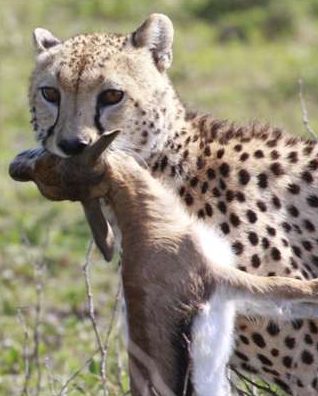
Cheetahs are the smallest of the three “big cat” predators. Unlike lions and leopards, which hunt mostly at night, cheetahs hunt during the day. They are visual predators and usually hunt on the open plain where their extreme acceleration and speed is an advantage. This means they can be easily observed – and in some cases disturbed - by safari vehicles if their guides don’t exhibit ethical behavior. If they are repeatedly interrupted during hunts, they may not be able to meet their nutritional needs or to feed their cubs.
Female cheetahs live alone or with their cubs. The females have very large territories. Cubs can stay with their mothers for a year or more. Many cubs die before they are grown. The cubs are often killed by lions. Male cheetahs either live alone or in groups of two or three individuals. These groups of males are called “coalitions.” Males usually have small territories, although some males range over large areas.
Ndutu is a good place for cheetahs because the plains, a preferred hunting area, are very close. This is especially valuable when the migration is in the area. Cheetahs primarily feed on Thompson’s gazelle but sometimes on other species, such as wildebeest calves. There are a fair number of cheetahs in Ndutu area. Cheetah sightings have increased somewhat during the last two years. This could be the result of increased effort and better data collection by the BCP. When we are able to identify individual cheetahs more easily by using AI, we will be able to track their abundance more easily.
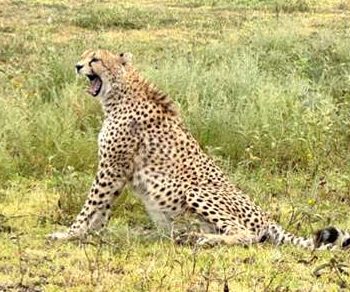
There are three “Marsh Brothers” male cheetahs that have occupied the western marsh area of Ndutu since about 2023. Their territory has expanded since then and the Marsh Brothers now often occupy the plains. Because they are a coalition of three, they can take larger prey, such as wildebeest, than a single cheetah. The Marsh Brothers were encountered repeatedly in 2024 and 2025. In 2024, we observed an encounter between the Marsh Brothers and hyenas. We sighted them at least 13 times in 2025. We observed them successfully hunting a baby wildebeest in February when 15 safari vehicles were present.
In 2024, one mother with three cubs was separated from one of her cubs by a low-flying balloon. By the next day, she had reunited with this cub. We observed a guide crunching a water bottle near a mother cheetah with a cub to attract her attention and get better pictures for his clients. This is not ethical guiding behavior.
| Year | Field days | Cheetah Sightings (per day) | Number non-cubs (per day) | Males | Females | Cubs |
|---|---|---|---|---|---|---|
| 2019-20 | 25 | 21 (0.8) | 32 (1.3) | 19 | 13 | 22 |
| 2020-21 | 3 | 2 (0.7) | 2 (0.7) | 0 | 2 | 1 |
| 2021-22 | 15 | 20 (1.3) | 20 (1.3) | 4 | 16 | 26 |
| 2022-23 | 30 | 25 (0.8) | 31 (1.0) | 13 | 14 | 16 |
| 2023-24 | 35 | 43 (1.2) | 57 (1.6) | 33 | 22 | 20 |
| 2024-25 | 38 | 34 (0.9) | 63 (1.7) | 44 | 19 | 13 |
| TOTAL | 146 | 145 (1.2) | 205 (1.6) | 113 | 86 | 98 |
Lions
Lions are the largest of Tanzania's big cats. There are about 3,500 lions in the Serengeti ecosystem. The Serengeti is famous for the Great Migration, where more than a million wildebeests and other grazers like zebras and antelopes migrate to find food and water. Lions take advantage of the migration to find abundant prey. Wildebeests are the most common prey but lions also hunt zebras, buffalo, other antelopes and even warthogs. When the migration is not present, times can be tough, especially for the cubs.
Lions live in family units called prides. A pride can consist of only a few adult females and their subadult and young cubs, or sometimes 15 or more individuals. A pride is defended by 1-3 males, occasionally more. Sometimes a male coalition will defend more than one pride. In Ndutu, the Wakazi brothers look over all four prides in the area.
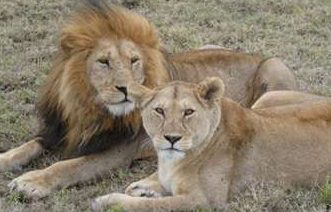
Females do most of the hunting, although the males hunt too. Most of the hunting takes place at night, and lions are often seen sleeping with very full stomachs during the day.
Lions make a lot of different sounds, include roars, grunts, moans, growls, snarls, meows, purrs, and woofs. Sometimes their roars can be heard up to 3 miles away! Lions can roar to stake out their territory or to locate other members of the pride. Lions can recognize each other from their roars.
There are four main lion prides in the Ndutu area. They often use the forested areas but when the Great Migration occurs, the lions will move out onto the plains.
The vastness of the plains provides areas where nomad lions can occur without being harassed by prides with territories in Ndutu. The term “nomads” typically refers to one or more adult male lions that do not belong to a pride. These males are often roaming between different prides, looking for opportunities to challenge the dominant males and take over their territories. Less often, there can be nomad females without a territory.
The abundance of prey items is seasonal. From about December through March (depending on the rains) there are many wildebeest, zebra, antelopes and other large animals. Once the migration of animals moves to the west and north to the Northern Serengeti and Maasai Mara, there are considerably fewer prey in the Ndutu area. At that time, lions hunt warthogs, sometimes giraffes, and other animals opportunistically. They become very thin during this period of low prey availability.
| Year | Field days | Lion Sightings (per day) | Number non-cubs (per day) | Males | Females | Cubs |
|---|---|---|---|---|---|---|
| 2019-20 | 25 | 38 (1.5) | 82 (3.3) | 23 | 56 | 9 |
| 2020-21 | 3 | 3 (1.0) | 9 (3.0) | 4 | 4 | 0 |
| 2021-22 | 15 | 14 (0.9) | 27 (1.8) | 7 | 15 | 7 |
| 2022-23 | 30 | 57 (1.9) | 162 (5.4) | 87 | 75 | 7 |
| 2023-24 | 35 | 54 (1.5) | 158 (4.5) | 63 | 77 | 20 |
| 2024-25 | 38 | 50 (1.3) | 145 (3.8) | 51 | 71 | 87 |
| TOTAL | 146 | 216 (1.5) | 583 (4.0) | 235 | 298 | 130 |
Ndutu Lion Prides
The BCP monitors four lion prides in the Ndutu area: the Backyard Pride, Marsh Pride, Thin Pride, and the Twin Hills Pride. Before Njozi Camp moved to its new location, the Backyard Pride was the closest to camp, thus its name.
Backyard Pride
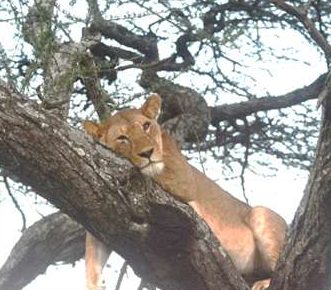
The Backyard Pride has five females. Until 2025, the five Wakazi Brothers were the males controlling this pride. The pride inhabits the area around the previous Njozi Camp location, not far from the marshes. We could collect data easily from them since they were near camp. They would roar in the early mornings when the guests were preparing for game drives as well as at night when the guests were having dinner.
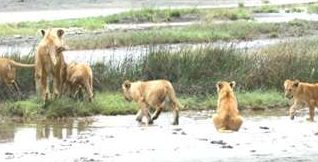
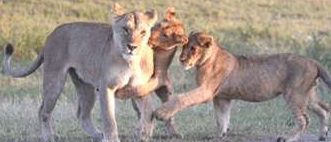
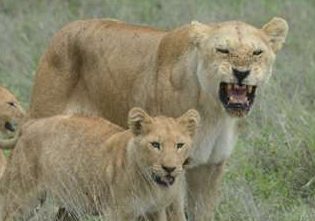
Marsh Pride – This pride typically resides in the western woodlands of Ndutu, occupying both the Big Marsh and Small Marsh areas. The Marsh Pride has been monitored since the start of the BCP in 2013-2014. This pride originated from Masek woodlands. During the time we have been observing the Marsh Pride, the number of lionesses has declined from a high of more than 10 to 8 in 2024, 3 in 2025 and only 2 in 2026. This is at least in part due to fragmentation of the pride when conditions were poor and prey was scarce. There have been many takeovers by new males, and many of the cubs were killed when takeovers happened. In 2022, the Marsh Pride was claimed by a coalition of five males known as the Wakazi Brothers. The Wakazi brothers dominated the Marsh Pride and the three neighboring prides until 2025. Wakazi is a Swahili word that means “residents” or “settlers.” They were named that because they managed to settle in an area that had been very unstable and where no other males had successfully settled for quite a long time. In March 2025, the Wakazi Brothers were kicked out of the Marsh Pride by Leremet and Lopir (who they had displaced from the Twin Hills Pride in 2024). They have not been seen since.
Whitey is a very well-known female in the Marsh Pride. She was born in 2009, and was 16 in 2025. She had her last two cubs in 2024. So far, she has not been seen in 2026.
Thin Pride
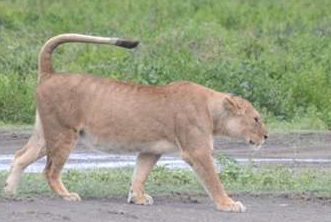
Since 2019, the lioness Laura has been the only adult member of the Thin Pride. Since her daughter disappeared in that year she has been alone, accompanied only by her cubs. Since 2021, she has had only male cubs so the pride has not grown. Laura had cubs in March 2023, but lost them by December when we returned to camp after the dry season. She had new cubs in December but all were males. As of 2025, The Wakazi Brothers controlled Laura’s Thin Pride.
Twin Hills Pride – Recently, the Twin Hills Pride has had more members than any other Ndutu pride. The thick Masek woodlands make it difficult to determine the exact number. Two males, In 2024, there were at least 18 females and 8 cubs. Leremet and Lopir, took over the pride in 2022. Then in 2024, the Wakazi brothers killed Leremet and kicked Lopir and his son out.
Interesting Sightings
7 March 2025. This was an exceptional sighting that involved cheetahs and lions. We were following the marsh bottom from the place where we left them the day before, but the next day was different. We started with a sighting of three youngster lions (two males, one female) that seemed to be by themselves without adults. All of these were of the same age (about 1 year). The youngster female was 120 m away from the two males. The males tried to hunt a young lone wildebeest who seemed to be lost from the rest of the herd. The lone young wildebeest caught our attention first. David anticipated that this young animal will not make it very long. The female lioness was injured on one of her feet and she was limping. The young males tried to hunt the young wildebeest but it was unsuccessful.
All of a sudden, two fully grown male lions (nomads) approached from a distance. When they were close, they started chasing the young boys – which was so intense. The boys covered a distance running away from the adult males. After observing all this for more than two hours, we decided to set up for breakfast. We realized we were on hyenas’ territory. More than 50 dens were around the area. Hyenas were everywhere. It seemed these young males had just escaped one trap to fall into another.
We got news from our guide friend that they saw the Marsh Brother cheetahs taking down a young wildebeest. We went there and found out it was the lone young wildebeest we saw earlier. Seeing the Marsh Brothers taking down a young wildebeest was an important observation for us. In all of the past five sightings, the Marsh Brothers were taking down young wildebeest. This showed us young wildebeests are a preferred prey.
Ndutu 2025 season
After the Wakazi brothers took over the Twin Hill Pride in 2025, they stopped visiting the marsh area, which had been the main territory of the Marsh Pride. With no males present after the Wakazis took over the Twin Hill Pride, the Marsh Pride females and their cubs were left without protection. This made the area open for other males to enter and try to take over.
In February 2025, we began seeing two male lions in the plains. Later that month, they moved into the marsh area. After this, the Marsh Pride females, led by Whitey and her family, started avoiding the marsh. They were often seen near the Backyard Pride territory, clearly keeping distance from the new males. When we identified the two males, we found that they were Lopir and his son. Lopir is a collared male who had been pushed out of the Twin Hill Pride by the Wakazi brothers after his coalition partner, Leremet, was killed during the takeover. Lopir and Leremet had controlled the Twin Hill Pride from 2022 until the end of 2024.
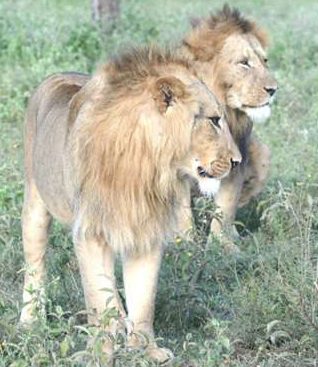
Up to now (January 2026), the Marsh Pride is still avoiding the marsh area. The last confirmed sighting of Lopir in the marsh was on December 31st, 2025, reported by Raymos. This means the Marsh Pride has avoided their prime area for almost a year, while Lopir and his son have settled there. At present, the Marsh Pride has only two adult females and four cubs. Whitey has been missing for some time, and we suspect she may have died. The last time the Marsh Pride was seen fully together (three females including Whitey and ten cubs) was in March out on the plains.
4 December 2025 – On the morning of 4th December, a female cheetah passed through the territory of the Marsh Pride. Whitey, Mama Jaw, and another adult female, accompanied by the cub Mikoba, were actively stalking a herd of wildebeest. While observing the hunting attempt, we noticed the cheetah moving through the marsh area, less than 100 meters from the lions, heading toward the woodlands. The lions’ focus on the wildebeest allowed the cheetah to pass unnoticed. The marsh environment continues to support the close coexistence of multiple species, including large predators, sharing the same space with minimal direct interaction.
12 January 2026 - After a heavy breakfast on the vehicle bonnet, we resumed our game drive. Just a few hundred meters away, we saw a cheetah profile on the plain - a raised tail, very small head and long slender body. We could tell it was a cheetah although it was still far away. Everybody was excited for their first cheetah of the day at 9:10 am. We approached gently to identify it was a female cheetah scanning a gazelle herd in the distance.
I spotted a sleeping male cheetah a few feet from the female. We noticed the female was seriously ready to hunt. She had locked onto a nearby gazelle as her target.
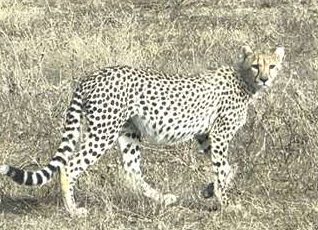
Fadhil was explaining that when cubs separate with their mothers, the siblings will spend time together. This can last for weeks up to months. It seemed these were siblings since we saw no indication of mating. In just a few minutes the female cheetah was close enough to the Thompson’s gazelle that she could take it down using full speed. The male cheetah stood up from nowhere and blew her cover. The gazelle saw him, and passed the signal to the whole heard. The male cheetah stood up again and patrolled through vegetation, in flash of a second coming up with a wildebeest calf. No chase, just on the go he stood up and strangled the calf.
The female cheetah approached him for sharing but he could not accept that. He would not share the kill.
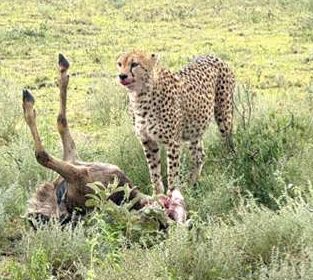
The female cheetah stood up and she started moving. She moved for a km or so away from the male. We saw a group of a few Grant’s gazelles ahead. Fadhil said there would be a successful hunt ahead of us so we repositioned on the side where we could see all the action like a panorama. It did not take minutes. She started trotting towards the group. The gazelle knew nothing about her. She locked her target on a calf that was acting playful. At full speed, just passing in front of one adult, she took down the calf. She went for the neck.
We watched her feeding. Maybe from what happened the sister will decide to separate with the brother, each taking their own way.
22 January 2026 – Shupavu hunting
We had multiple encounters with Shupavu during the 2024-25 season. Shupavu was very shy male leopard. At that time, it seemed that he had recently separated from his mother.
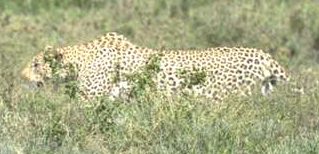
Last year, he would hide under thick vegetation where he could spend even hours when safari vehicles surrounded him - or else he would be perched on the very top canopy of trees, hardly to be seen. We could tell him from body size and behavior.
This current season we have seen much growth in Shupavu. He has grown in size and is no longer a shy male. In most of encounters with him, he is observed with a kill, or attempting to hunt. On 15 January 2026 he was hunting with numerous vehicles around him and he took down a wildebeest calf. We also saw him with a Grant’s gazelle he dragged up in a tree. Shupavu means strong, tough or brave.
African Carnivore Wildbook
Tech 4 Conservation, in addition to its Argus Wild AI for animal researchers, also has The African Carnivore Wildbook, which is AI generated software that allows citizen scientists (for example, safari guests) to take photos of individual big cats and upload the photos into the African Carnivore Wildbook database. The photos you take of cheetahs, lions, and leopards can help advance the BCP by increasing the number of photo observations. The more people who share photos the better! Uploading your photos is easy and they can be used by BCP biologists to augment the photos they take and learn more about big cats.
You can upload your photos through the African Carnivore Wildbook website. You will also need to provide information about where you took your photos. The website tells you what to do. In the “NOTES” field you can write “for BCP” and we’ll know you are supporting our project.
Here is the African Carnivore Wildlife website: https://africancarnivorewildbook.com.
Big Cats and Tourism
Seeing the big cats of the Serengeti is one of the highlights of almost every visitor’s trip. There is nothing like watching a cheetah hunt, seeing a litter of lion cubs playing while the rest of the pride rests, or spotting a leopard high in a tree with its kill. But if not done carefully – “ethically” as out biologists and guides describe it – it can interfere with the cats’ ability to hunt, rest and take care of their cubs.
Here are a few things to remember when on your safari, whether at Njozi Camp with us or elsewhere on your safari:
- The Wild Source guides are great naturalists who have been observing lions, leopards, and cheetahs for years. They have extensive knowledge and experience with the big cats, which they will happily share with you to make your safari a trip of a lifetime. Following their recommendations on what to do, and not do, when you’re observing the cats will enhance your adventure and minimize impacts on the cats.
- Watch carefully from a distance before you encourage your guide to move closer. See what the animal is doing, whether it is nervous or not, and whether it appears to be uncomfortable when your vehicle gets closer. Some of the most precious moments come when you are viewing the cats undisturbed – even when a bit farther away.
- Don’t make sudden movements, talk loudly, hang out the window, or try to get cats to react “for a better picture” by make loud or unusual noises. It is much more interesting – and better for them – if you watch when they are doing something natural, not responding to your presence.
- Don’t encourage your guide to chase an animal when it is hunting. It may be exciting for you, but may ruin the hunt. The cat you are chasing – or surrounding before it has a chance to chase – may miss an important meal or be unable to feed its cubs.
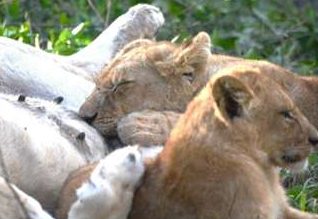
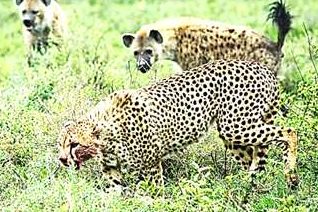
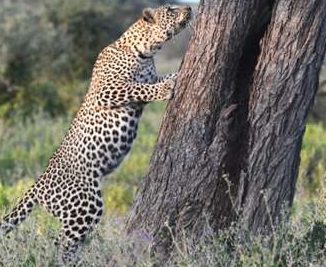
We want our visitors to have a fantastic safari, and experience the magic of seeing cheetahs, lions and leopards. But we also want the cats to successfully hunt, feed their cubs, rest and play. Taking care of our big cats now will ensure that they are here not only for us but when others come in the future.
Support
If you would like to support the Big Cat Project, you can make a tax-deductible donation to The Wild Source Foundation, a 501(c)3 non-profit.
1) Click the button below to donate via PayPal
2) Mail a check to:
The Wild Source Foundation
801 14th St.
Golden, CO 80401
*Please note that your donation is for the Big Cat Project.
Thank you for helping us make a difference for wildlife…it matters!